Whisky casks range from the 50-litre octave to the 700-litre gorda, and the size you own decides how fast the spirit matures, how much liquid is left after years of evaporation, and how many bottles come out at the end. For Scotch specifically, the law caps the ceiling: Scotch Whisky must be matured for a minimum of 3 years in oak casks not exceeding 700 litres. Below that, the shape and size of the cask are a mix of tradition, physics, and what the previous occupant (bourbon, sherry, port, wine) left behind in the wood.
Why cask size matters more than people assume
Whisky matures through contact with the inside of the wood. The ratio of liquid to surface area is doing most of the work: breathing through the staves, pulling colour and compounds out of the oak, and losing some volume to evaporation along the way.
Smaller casks offer a greater surface area-to-volume ratio, accelerating maturation and intensifying flavours, whereas larger casks allow for slower, more nuanced ageing. In practice that means the smaller the cask, the greater the proportion of spirit in contact with wood, and the faster flavour, colour, and tannin are extracted. A spirit in an octave can take on heavy wood character in a few years. A butt filled the same day may still be gaining complexity a decade later.
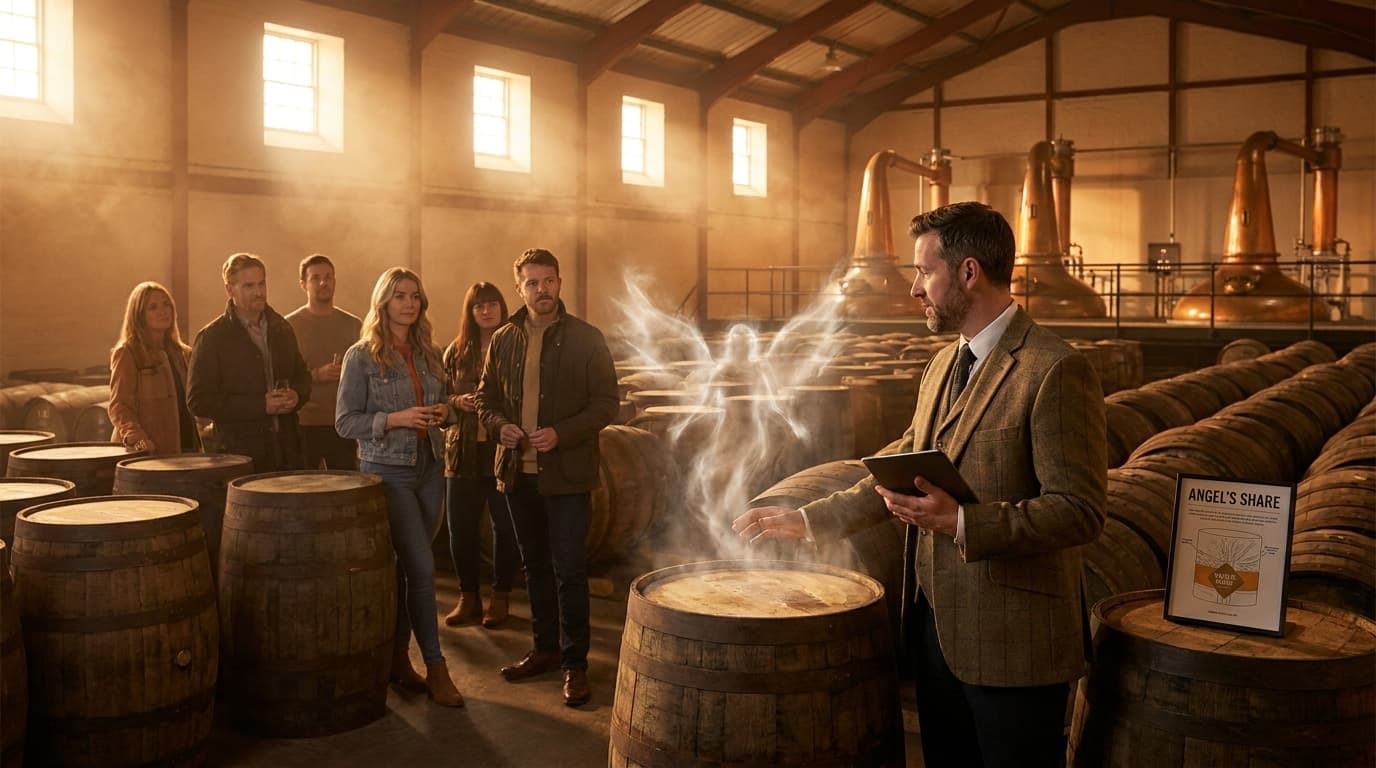
Size also sets your evaporation profile. The same climate takes a bigger percentage off a small cask than off a large one, because the surface area dominates. For how that interacts with time in bond, see how the angel's share works.
The main whisky cask sizes
Industry names are not perfectly standardised, so you will see small variations in litreage between sources. The ranges below cover the figures used across the trade.
Octave (around 50 litres)
The smallest cask in common use. An octave is roughly a quarter of an American Standard Barrel at about 50 litres, and these tiny casks are usually used for finishing because of how quickly they impart flavour. You will see octaves used for short "finishing" periods or by independent bottlers running limited releases.
Quarter cask (around 45 to 50 litres)
Similar size to an octave, slightly different shape and history. Quarter casks hold roughly 45 to 50 litres. Laphroaig popularised the format in modern Scotch, but it is now used across the industry for accelerated maturation or final-stage finishing.
American Standard Barrel (around 200 litres)
The workhorse of the Scotch industry. The American Standard Barrel (ASB) has a capacity of 180 to 200 litres, is made of American white oak, and is the most common type and size of cask in use today. A typical bourbon barrel, known as an ASB, holds 200 litres; in Scotland, hogsheads have prevailed, with a volume between 225 and 250 litres.
The reason you see so many ASBs in Scottish warehouses is simple: US law requires bourbon to be aged in new charred oak, so once a bourbon distillery has used a barrel it is sold on, and Scotland is the largest buyer.
Hogshead (around 225 to 250 litres)
Not a cask in its own right so much as a reconstruction. While the American Standard Barrel usually has a volume of around 200 litres, the hogshead is rebuilt to a volume of between 225 and 250 litres, allowing a few litres more whisky to mature without affecting stability. A cooper takes the staves from several ex-bourbon barrels and remakes them into a slightly larger shape. Hogsheads are half the size of a butt at 250 litres capacity.
Barrique (around 250 to 300 litres)
A shape borrowed from the wine trade. A barrique is like a larger hogshead with the long shape of a butt, holding around 250 litres, and comes from the wine industry. Expect to see it quoted on casks finished in red wine or ex-cognac.
Puncheon (around 450 to 500 litres)
Puncheons are around 500 litres and come in two styles: the "machine puncheon", short, fat, and made from thick American oak staves, and the "sherry shape puncheon", more elongated and made with thinner Spanish oak staves. Machine puncheons are associated with rum, sherry-shape puncheons with Spanish fortified wines.
Butt (around 475 to 500 litres)
The archetypal sherry cask. A butt can hold approximately 475 to 500 litres of whisky, making butts twice as large as a hogshead and two and a half times the size of a barrel. Butts previously held sherry (oloroso and Pedro Ximenez being the most common) and command a premium when the sherry provenance can actually be proved. If a seller is quoting a "sherry butt" price, see what to verify on re-racked and finished casks before paying it.
Port pipe (around 500 to 650 litres)
The port pipe is a large barrel from port wine production, closely related to the sherry butt, with a capacity usually around 500 litres but reaching up to 650 litres.
Gorda (around 700 litres)
The upper legal limit for Scotch. Gorda casks hold 700 litres, are made from American oak, and are traditional to the American whiskey industry but not often used for Scotch maturation because their capacity is too large. You will rarely encounter one as an investor.
Why 700 litres is the legal ceiling for Scotch
The 700-litre figure is not arbitrary. The Scotch Whisky Regulations 2009 specify that Scotch Whisky must be matured in Scotland in oak casks of no more than 700 litres in volume, with oak specified by law because of its particular effect on the maturing spirit. The statutory instrument sits on legislation.gov.uk (The Scotch Whisky Regulations 2009). Anything matured outside that envelope is not Scotch, regardless of what the label says.
Other whisky categories, from Irish to American to Japanese, apply their own cask rules. If you own a non-Scotch cask, do not assume the 700-litre ceiling applies.
What cask size means for your paperwork
Cask size shapes three numbers that appear on every honest cask record: the bulk litres (total liquid in the cask), the alcohol strength (ABV), and the litres of pure alcohol (LPA). The last of these is the one that matters for duty, insurance, and resale.
OLA stands for "Original Litres of Alcohol" and RLA stands for "Regauged Litres of Alcohol". OLA refers to the number of litres of pure alcohol initially placed into the cask, and RLA represents the litres of pure alcohol remaining at the time of regauge. A butt will have a much larger OLA than an octave filled with the same spirit, but over the same period of maturation the octave will usually lose a bigger share of its contents in percentage terms.
If you are buying a secondary-market cask, the size on the delivery documentation should match the warehouse's gauging record. For how to read those numbers properly, see the whisky cask regauge explained. The bottle yield at the end also follows from the RLA, not the bulk litres; how bottling a cask works walks through the arithmetic.
Because there is no central UK register of cask ownership, cask size, strength, and warehouse location only mean something when the paperwork can be matched against an independent record. CaskID is an independent register that cross-checks cask details against the bonded warehouse record so a stated size, OLA, and location can be verified against source.
Key takeaways
- Whisky casks run from around 50 litres (octave) to 700 litres (gorda), with the ASB (around 200 litres) and hogshead (225 to 250 litres) dominating Scotch warehouses.
- The Scotch Whisky Regulations 2009 cap maturation casks at 700 litres; anything larger cannot legally be Scotch.
- Smaller casks mature faster and lose a greater percentage of volume; larger casks age more slowly and hold more spirit.
- A "butt" is roughly twice a hogshead and 2.5 times a barrel, which is why sherry-butt pricing is so different from ex-bourbon pricing.
- Cask size by itself proves nothing: the number you care about on paperwork is the RLA, verified against the warehouse's gauging record.
Frequently asked questions
How many bottles come out of a whisky cask?
It depends on the cask size, the alcohol strength at bottling, and how much liquid remains after evaporation. As a very rough guide, an ex-bourbon barrel might yield around 200 to 250 standard 70cl bottles after a decade or so, and a sherry butt perhaps double that. The accurate figure comes from the RLA at regauge, not the original fill.
Is a hogshead the same as a bourbon barrel?
Not quite. A hogshead is normally rebuilt by a cooper from the staves of ex-bourbon barrels into a slightly larger cask of 225 to 250 litres. A standard ex-bourbon barrel (an ASB) is around 200 litres and keeps its original dimensions.
Does a bigger cask always mean better whisky?
No. Larger casks mature spirit more slowly and more subtly, which suits some styles and some distilleries. Smaller casks extract flavour and colour faster, which can be an advantage for finishing or short maturation but can also push a spirit into over-oaked territory. "Better" is a function of spirit, wood, time, and climate, not litreage alone.
Sources
- scotch-whisky.org.uk: protecting scotch whisky
- globeinndumfries.co.uk: strs
- masterofmalt.com: size matters a guide to cask size in whisky
- marklittler.com: cask whisky faq
- diffordsguide.com: casks barrel butt punchon pipe barriquehogshead
- whiskipedia.com: bourbon casks
- whiskipedia.com: hogshead whisky barrel
- theglenlivet.com: types of whisky casks
- topwhiskies.com: a guide to whisky cask sizes and types
- whiskyforeveryone.blogspot.com: explain about whisky cask types and
- whiskyshop.com: what are the different whisky cask sizes
- whisky.com: whisky cask sizes