What the angel's share actually is
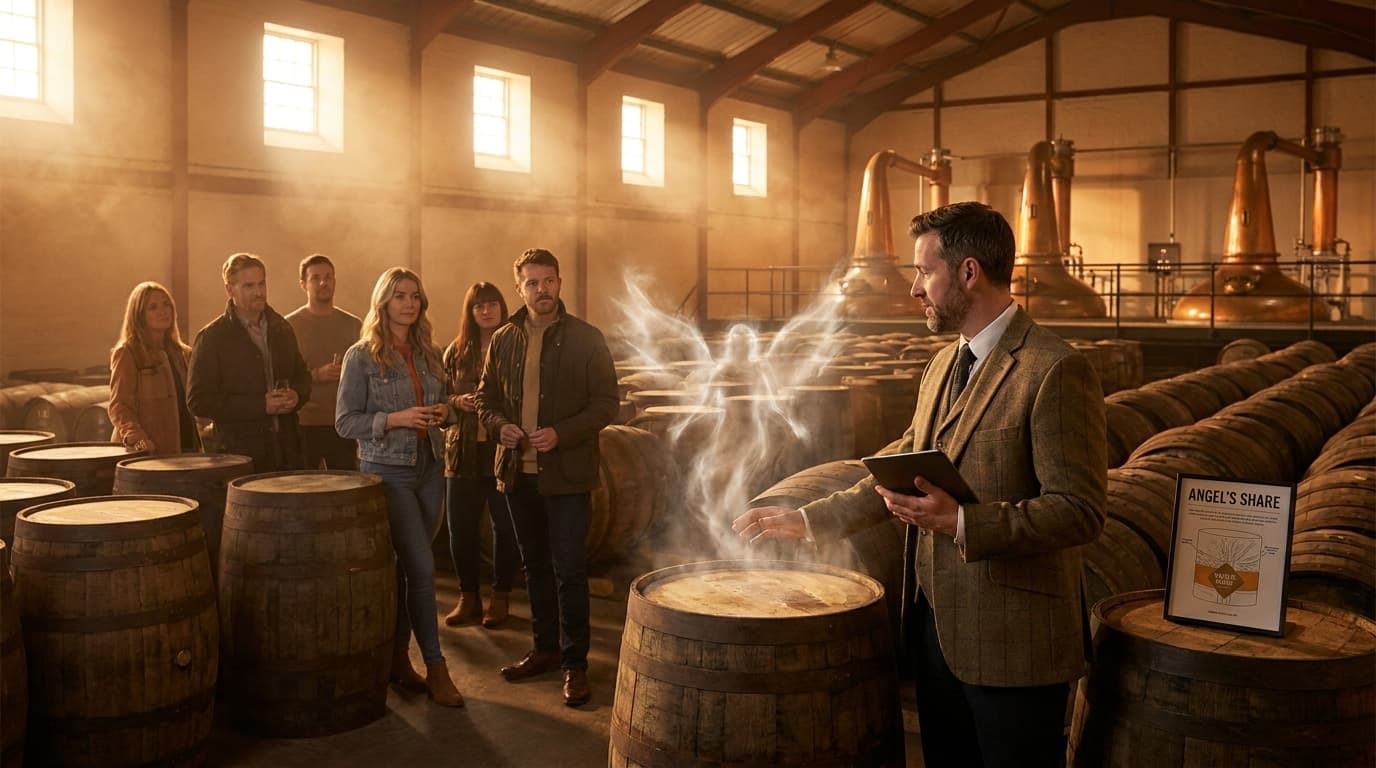
The angel's share is the whisky that evaporates from a cask during maturation. In Scotland, distillers typically lose around 2% of a cask's contents each year, though the exact figure depends on climate, cask size, warehouse style, and age. For a cask owner, this matters for two reasons: the amount of liquid in the cask shrinks every year, and the alcoholic strength usually drifts downward with it.
Why whisky evaporates from a sealed cask
A cask looks sealed, but oak is not. In Scotch whisky production, the angel's share refers to evaporation loss during cask maturation, which occurs because oak is a porous material, allowing both water and alcohol molecules to pass through. Air moves in, vapour moves out, and the wood itself absorbs liquid, especially early on.
The rate at which this happens is driven by temperature and humidity in the warehouse. Cool, damp warehouses lose spirit more slowly. Warm, dry ones lose it faster. That is why the headline 2% figure is only an average: a cask racked in a stone-walled dunnage warehouse on the Scottish coast will not behave the same way as one stacked high in a modern palletised warehouse further inland.
Early years tend to lose more
Newly filled casks often lose more liquid in the first 12 to 24 months as liquid is absorbed into the wood. This is one reason why a cask that is six years old will not have lost exactly 12% of its fill. Expect a steeper drop at the start, then a slower, steadier loss afterwards.
How evaporation changes ABV, not just volume
This is the part that beginners most often miss. Evaporation does not just take whisky away in equal proportions. It changes the ratio of water to alcohol.
In Scotland's relatively cool and humid climate, alcohol tends to evaporate slightly faster than water, meaning ABV can slowly decrease as the whisky ages. In warmer, drier climates such as Kentucky for bourbon, water loss can be greater, causing ABV to rise.
For a Scotch cask filled at around 63.5% ABV, decades of maturation can pull the strength down into the 40s. For a bourbon barrel in Kentucky, the opposite is often true: the barrel can finish stronger than it was filled.
The 40% floor matters
There is a hard legal limit under which this becomes a problem. The Scotch Whisky Regulations 2009 require Scotch whisky to be bottled at no less than 40% ABV. For very long aged Scotch, producers need to ensure that it doesn't reduce in alcohol strength so much that it drops below 40% ABV. A cask whose contents have dropped below the legal minimum cannot be bottled and sold as Scotch Whisky. For an owner, that is not a theoretical concern on a 40-plus year cask filled on the low side.
How much is "normal"? Country by country
Evaporation varies enormously by climate.
- Scotland: typically around 2% a year on average.
- Rest of the world: elsewhere in the world the loss can be as high as 5% per annum.
- India: the rate of evaporation is around 12% per year, which is one reason Indian single malts mature quickly in sensory terms but produce far smaller volumes of saleable spirit.
These are averages, not promises. Any projection a seller gives you for "future bottles" based on today's volume is already assuming a loss rate that may or may not materialise.
What this means for cask owners
The angel's share is the gap between what you buy and what you can actually bottle. A 250-litre hogshead filled at 63.5% ABV contains roughly 159 litres of pure alcohol on day one. Ten years later, after evaporation and some strength loss, it may contain substantially less, both in bulk and in pure alcohol terms.
That is why the two numbers that actually describe a cask are:
- Bulk litres (BL): the volume of liquid in the cask.
- Litres of pure alcohol (LPA or RLA): bulk litres multiplied by ABV gives the measure the whisky industry uses to account for the alcoholic content of a spirit.
LPA is what you pay duty on, what determines how many bottles you can fill at a given bottling strength, and what moves most when a cask ages. A headline "250-litre cask" tells you almost nothing about either figure after a few years. For a fuller walk-through of these calculations, see our guide to LPA calculations and independent verification.
Why a regauge is the only honest answer
The only reliable way to know what is actually in your cask today is a regauge. A sample is drawn and tested to determine the alcoholic strength: the ABV, which must be above 40% for it to be legally termed whisky. The full cask is weighed, the weight recorded, then the cask is emptied and the unfilled weight is recorded. The difference, combined with the ABV reading, gives current bulk litres and current LPA.
If you have not seen a dated, warehouse-issued regauge for your cask, you do not know what you own in bottling terms, you only know what you were told you own. See our longer explainer on what a regauge is and how to read one.
Why the angel's share is also a verification question
Evaporation is natural. The problem is that it gives sellers a convenient story. Headline projections for "future bottle counts" or "40-year performance" assume a stable loss rate, no cask damage, no re-racking, and an ABV that stays above 40%. None of those are guaranteed. CaskID exists as an independent register for verifying whisky cask ownership and the documentary trail behind it, so an owner can test what a seller or broker claims against warehouse records rather than taking it on trust.
The practical takeaway is simple: ask for current numbers, not projected ones, and expect them to be backed by a regauge from the storage warehouse. The angel's share also sits inside the broader ongoing costs of owning a cask, because every year of storage is another year of loss.
Key takeaways
- The angel's share is natural cask evaporation, averaging around 2% a year in Scotland but much higher in hot climates such as India.
- Oak is porous, so both water and alcohol leave the cask over time; the ratio of the two depends on warehouse humidity and temperature.
- In Scotland, ABV usually drifts down with age; in Kentucky, it often rises. For Scotch, the legal floor is 40% ABV at bottling.
- The useful measurement of a maturing cask is litres of pure alcohol (LPA), not the original cask size.
- A current, warehouse-issued regauge is the only credible way to know what is actually in your cask today.
Frequently asked questions
Does the angel's share stop at some point?
No. It slows after the first couple of years but continues for the life of the cask. The longer the maturation, the more volume and, usually in Scotland, the more alcoholic strength is lost.
Can a cask of Scotch become legally unsellable because of evaporation?
Yes. If the ABV drops below 40% it cannot be bottled and sold as Scotch Whisky. For very old casks filled at modest strength this is a real risk, which is why ABV should be checked at regauge rather than assumed.
Why does bourbon get stronger with age but Scotch gets weaker?
It comes down to climate. In Scotland's cool, humid warehouses, alcohol evaporates slightly faster than water, so ABV falls. In Kentucky's hotter, drier conditions, water tends to evaporate faster, so ABV rises.