Whisky matures in a cask because oak is porous and chemically active. Over time the spirit draws flavour and colour out of the wood, loses harsh compounds through the staves, and reacts with small amounts of oxygen that seep in. The cask is not a passive container; it is the single biggest influence on what the finished whisky tastes like, and the law reflects that by prescribing what a cask must be and how long the spirit must sit in it.
The legal starting point: what counts as maturation
Before covering the chemistry, it helps to understand what the law actually requires, because every claim about "aged" Scotch rests on it. Under Regulation 3 of the Scotch Whisky Regulations 2009, Scotch Whisky must be matured in an excise warehouse in Scotland, in oak casks of a capacity not exceeding 700 litres, for a period of not less than three years. The regulations came into force on 23 November 2009.
The three-year minimum is not a quality threshold chosen by distillers. It originates in the Immature Spirits (Restriction) Act 1915, introduced by David Lloyd George as a wartime compromise with distillers after he had argued for far tighter restrictions on drink. Everything the industry now says about "well-aged" Scotch sits on top of a rule designed to reduce consumption a century ago.
The regulations also require the finished whisky to retain the character the raw materials and the maturation process give it. The Scotch Whisky Association's guidance on allowable casks confirms the cask must be made of oak and the spirit must retain the colour, aroma and taste derived from its production and maturation. The cask is written into the definition of the spirit.
What goes into the cask on day one
New make spirit is clear, high strength, and nothing like finished whisky. According to the Scotch Whisky Association's FAQs, when distilled it is usually reduced for filling into casks at a strength of 63.5% ABV. That dilution matters. Higher strengths pull different compounds out of the oak than lower strengths, and the fill strength is one reason two casks from the same distillery can age at different rates.
From that moment, three things happen in parallel. Distillers and researchers usually split them into additive, subtractive and interactive maturation. Each one explains a different part of what the cask does.
Additive maturation: what the oak gives
Additive maturation is the material the spirit pulls out of the wood. Oak is not inert. As the Cotswolds Distillery explains, alcohol is a non-polar solvent that can dissolve both water- and fat-soluble compounds in the oak, and lignin in the wood's cell walls breaks down under the influence of the spirit, releasing flavour compounds including vanillin. Vanillin is the compound that gives vanilla its smell; oak lactones add coconut and sweet-wood notes; tannins contribute structure and a drying mouthfeel; and hemicellulose breakdown contributes caramel and toffee flavours after a cask has been toasted or charred.
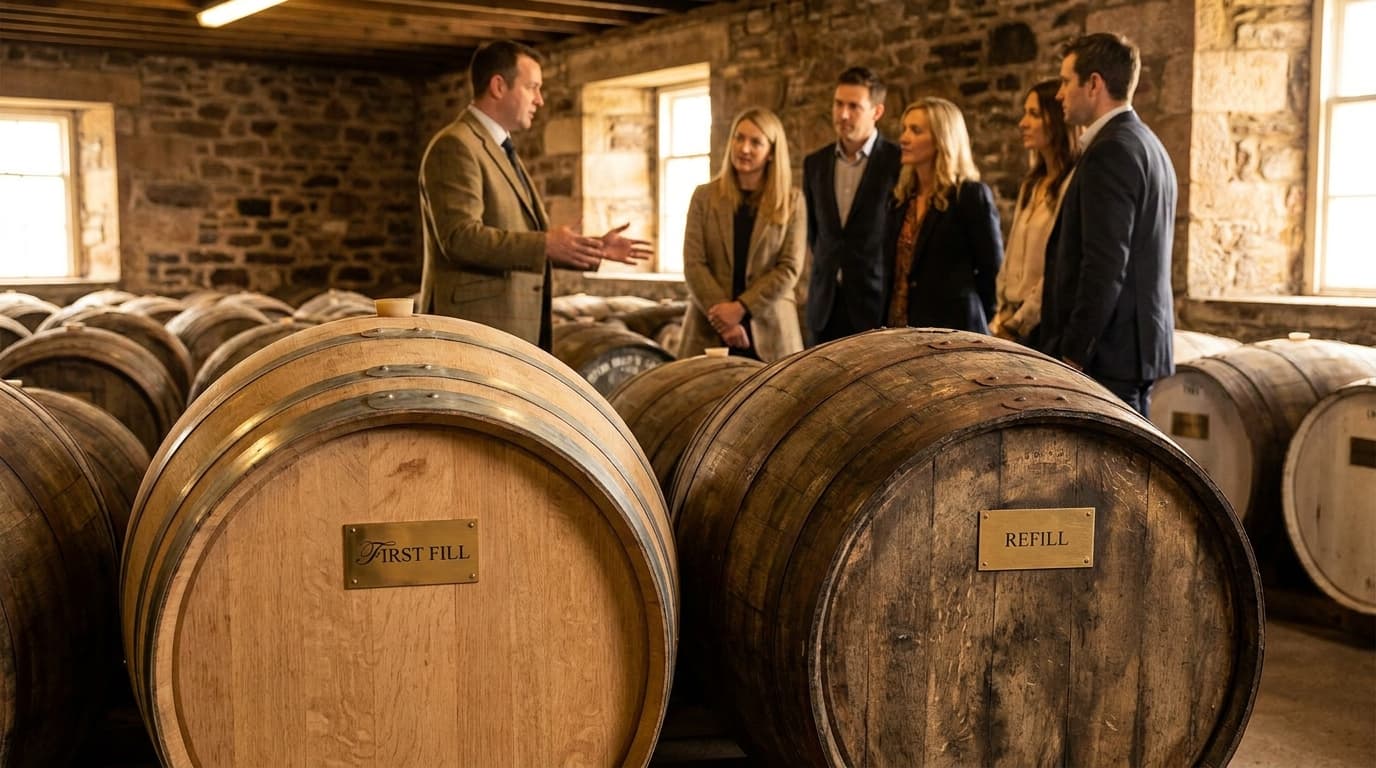
How much the oak still has to give depends on what it has already held. A cask that has previously held bourbon or sherry has donated some of its extractives before it ever meets Scotch spirit, which is why the difference between first fill and refill casks is one of the most consequential facts about any individual cask.
Subtractive maturation: what the oak takes away
Subtractive maturation is the mirror image. New make spirit contains volatile and sulphurous compounds that are unpleasant on their own. During maturation some pass out through the oak or are absorbed into the charred inner layer of the staves, leaving a smoother, less aggressive spirit. Cask size matters here: smaller casks give a higher surface-area-to-volume ratio and work faster in both directions, which is one reason the 700-litre ceiling exists in law.
Interactive maturation: oxygen, heat and time
Interactive maturation is the slower set of chemical reactions inside the liquid itself, driven by small amounts of oxygen entering through the porous staves and by seasonal temperature changes that move the spirit in and out of the wood. Esters form, acids and alcohols combine, and sulphury notes oxidise away. This is the part of maturation that cannot be rushed, and it is why a 20-year-old whisky does not taste like a scaled-up five-year-old.
Temperature and humidity in the warehouse decide how fast all of this moves. Dunnage, racked and palletised warehouses each give different conditions, which is one reason where your cask is actually stored is more than a bookkeeping detail.
The angel's share: what you lose while you wait
Casks are porous, so a cask loses liquid every year to evaporation. The Glenlivet's own explanation of the angel's share puts the typical Scottish figure at around 2% of a cask's contents each year. In a cool, humid Scottish warehouse the loss is usually proportionally greater in alcohol than in water, so ABV drifts downwards over time. This is why a cask can finish maturation at a very different strength from the 63.5% ABV it was filled at, and why strength and volume both have to be re-measured before any serious transaction.
Over long maturations the losses compound. A cask that loses roughly 2% a year is noticeably lighter at ten years and dramatically lighter at twenty, which has direct implications for what a bottling will yield and what the cask is worth. For more detail on how the loss splits between alcohol and water, see our longer piece on angel's share evaporation.
The bottle at the other end
The spirit cannot be sold as Scotch below a set strength. The same SWA FAQ confirms that the minimum bottling strength is 40% ABV. If maturation and the angel's share have brought a cask too close to 40%, the owner has a decision to make, because once a cask drops under the threshold it cannot legally be bottled as Scotch at all. For very long-aged casks this is a real risk, not a theoretical one.
Why maturation matters for cask owners
For anyone who owns a cask as an investment rather than as a drink, maturation is the whole proposition. The oak, the warehouse conditions, the fill strength, the number of previous fills, and the time that has already passed all determine what the cask will yield and what it is worth today. None of those facts are self-evident from a certificate; they have to be checked against distillery and warehouse records. CaskID exists as an independent register for verifying whisky cask ownership and the records that sit behind it.
A broker's spec sheet may describe a cask as "first fill sherry" or quote an original fill strength, but the only way to know what is actually in the warehouse today is to see the current warehouse keeper's records and a recent regauge. For buyers on the secondary market, that documentation is the real asset.
Key takeaways
- Scotch must be matured in oak casks of up to 700 litres, in a Scottish excise warehouse, for at least three years; the three-year rule dates from 1915.
- Maturation combines what the oak adds (vanillin, lactones, tannins), what the oak removes (harsh volatiles), and what oxygen and time do to the liquid itself.
- Scotch is typically filled at around 63.5% ABV and must be bottled at a minimum of 40% ABV, so long maturations risk falling below the legal threshold.
- Scottish warehouses typically lose around 2% of a cask's contents a year to the angel's share, and the loss is not evenly split between alcohol and water.
- The individual history of a cask, including fill number, warehouse conditions and current strength, determines its value, and all of it should be verifiable against primary records.
Frequently asked questions
Can whisky mature in a bottle?
No. Once whisky is in glass it is in an inert container and no significant maturation takes place. All the chemical changes described above require the spirit to be in contact with oak and with the small amount of oxygen that comes through the staves. A 12-year-old whisky bottled in 2000 is still a 12-year-old whisky today.
Does older always mean better?
No. Longer maturation gives more interaction with the oak, but it also means more angel's share, lower strength, and in some casks a point at which the wood starts to dominate the spirit. A cask that was active and well-balanced at 15 years can taste over-oaked at 25. Age statements describe time, not quality.
Why do some whiskies get finished in a second cask?
"Finishing" means transferring the maturing spirit into a different type of cask (often sherry, port or wine) for a shorter period at the end of maturation. The aim is to add character from the second cask on top of what the first one gave. For a cask owner this matters because the resulting whisky can only be described using what the records actually prove about both casks.