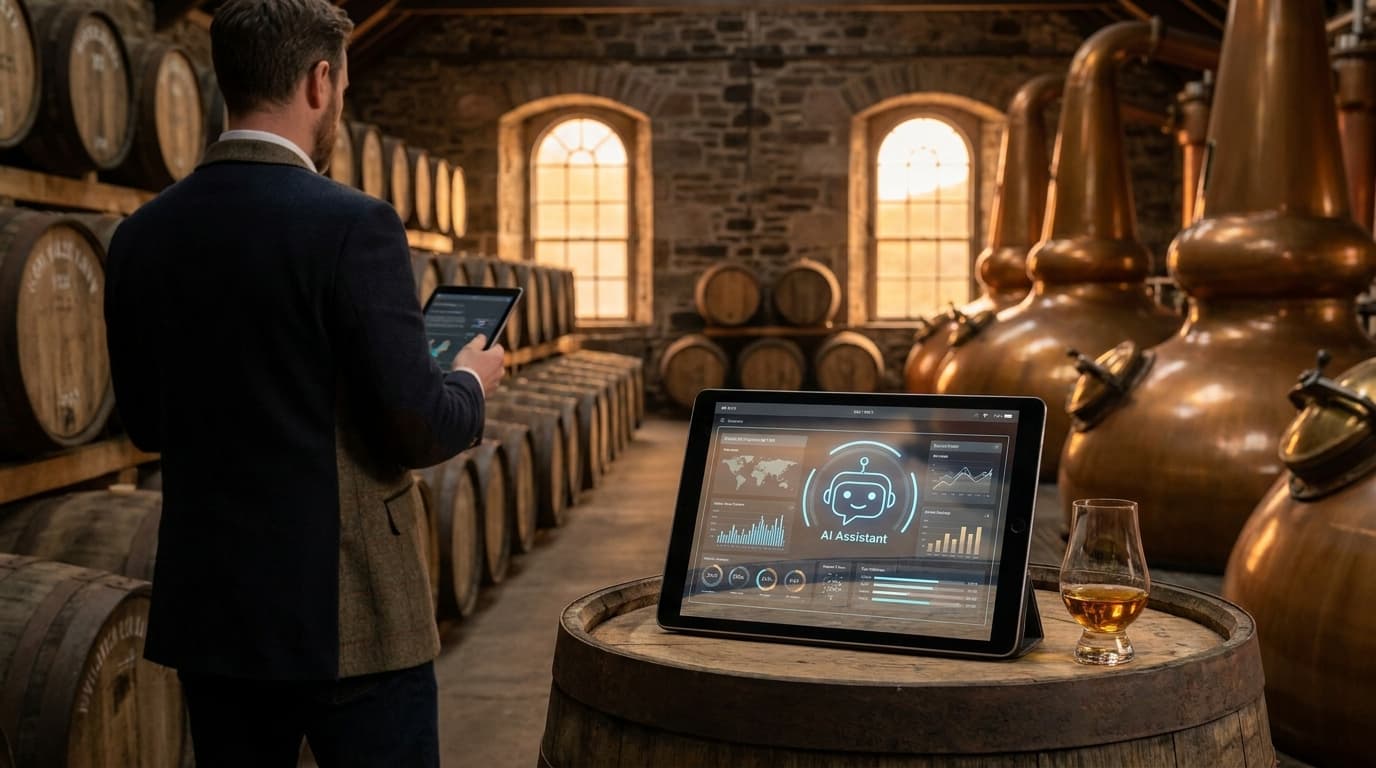
On 25 July 2026, a new kind of tool appeared in the Scotch whisky market. Caskd, a UK peer-to-peer whisky marketplace that itself only opened in June, launched CaskdAI: a specialist AI assistant aimed at collectors, enthusiasts, and cask investors. It is not the first artificial intelligence product to reach the drinks industry, but it is one of the first pitched squarely at the investment audience.
For anyone who has spent time researching cask ownership online, a purpose-built AI is a welcome shortcut through a lot of noise. General-purpose chatbots handle whisky questions unevenly, and broker-run "advice" pages are rarely neutral. A dedicated model trained on distillery data, cask types, and auction results is a genuinely useful reference tool.
But investment decisions are not answered by references alone. A cask is a physical object in a bonded warehouse, with a chain of title, a set of documents, and a market value that depends on both. No AI can look inside a warehouse. And that is the distinction cask investors need to understand before letting an assistant, no matter how well-tuned, shape a buy or sell decision.
What CaskdAI actually is
CaskdAI sits inside Caskd, a marketplace launched on 25 June 2026 by Harrogate entrepreneur Jonathan Yates. The stated aim of Caskd is to let whisky enthusiasts trade directly and avoid the fees, premiums, and settlement delays associated with traditional auction houses, while offering a place to manage collections and track provenance.
The AI assistant, announced in late July 2026, is described by its makers as combining industry knowledge with market intelligence to help collectors, investors, and enthusiasts make informed decisions. In practice, that means it can answer questions about distilleries, cask types, historical market movements, and the general shape of the collectible whisky world.
That is a step up from asking a generalist chatbot about the difference between a hogshead and a butt. It is not, however, a verification tool. And the launch is a good moment to be clear about what AI can and cannot do in this market.
What AI can genuinely help investors with
Used properly, an AI reference tool has real value in whisky research.
- Understanding cask types, ages, and yields. The interaction between cask type, fill strength, warehouse conditions, and expected outturn is not intuitive. A trained model can explain it consistently.
- Contextualising auction data. AI is good at surfacing patterns in publicly reported auction results and giving a rough sense of where a distillery sits in the market.
- Explaining terminology. WOWGR, RW, OLA, LOA, ABV, angel's share: the jargon around cask investment is dense, and a well-trained assistant is a fast reference.
- Framing the tax and regulatory landscape. General points about VAT, duty, CGT treatment, and the unregulated status of the cask market can be summarised clearly.
None of that replaces professional advice, but as a starting point for research, an AI assistant is useful. It becomes a problem only when investors, or the sales pitches aimed at them, treat that same tool as evidence about a specific cask.
Where AI cannot help: cask-specific verification
An AI assistant, no matter how specialised, cannot verify the three questions that decide whether a cask investment is real:
Does the cask actually exist?
A cask is a physical object under HMRC bond. Confirming its existence requires the warehouse operator to look at its own records and, ideally, at the cask itself. No AI has access to warehouse stock systems. It can tell you what a distillery's cask numbering conventions look like; it cannot confirm that cask 4823 exists in bay 7 of a specific warehouse today.
Who actually owns it?
This is the point where the market's structural gap becomes obvious. The Finance Act 2006 removed the legal standing of Delivery Orders as documents that transfer title on their own. Whisky cask investment in the UK is not regulated by the Financial Conduct Authority, which means investors do not benefit from Financial Services Compensation Scheme cover or Financial Ombudsman recourse. HMRC does not maintain a register of cask-level ownership. There is no single national database an AI could query even if it wanted to.
An AI can explain that gap, and a good one will. It cannot fill it.
Is the cask being sold twice, or shown as multiple casks?
The BBC Scotland Disclosure programme "Hunting the Whisky Bandits", which producers described as investigating "serious organised crime", set out cases where casks were overpriced, sold to multiple buyers, or did not exist at all. Independent old and rare spirits consultancy Wisgy published its "Secret Whisky Cask Broker" interview in September 2025 describing similar practices. In July 2026 the ASA ruled again against Capgroup Int, formerly known as London Cask Company and Caskcap, over misleading review scores and missing risk warnings.
Those are patterns a general AI cannot detect at the individual cask level. A photograph of a cask end can be reused across listings. A cask number can appear on multiple broker sites at once. Spotting that requires either warehouse-level cooperation or image analysis against a live database of previously submitted casks. It is not a job for a chatbot.
Independent verification is a different technical problem
There is a distinction worth drawing between two uses of AI in this market. General assistants like CaskdAI are aimed at answering questions in natural language. Independent verification tools use AI in a much narrower way: to compare a submitted cask photograph against everything else that has been submitted, flag duplicates, and cross-check the accompanying documents against the warehouse of record.
CaskID is the independent register set up specifically for this purpose, verifying whisky cask ownership by combining owner, broker, warehouse, and distillery input rather than relying on a single document or a single seller's word. That is the technical gap AI can help close, but only when the model is pointed at a real dataset of casks rather than at general market commentary.
Using AI tools without over-relying on them
For cask investors, the practical rule is straightforward:
- Use AI for research, definitions, and market context.
- Never treat AI output as verification of a specific cask.
- Ask the seller for the warehouse of record, the WOWGR-authorised owner, and up-to-date regauge data.
- Confirm the cask directly with the warehouse where possible, or through an independent verification service that does.
- Keep documentary evidence (invoice, Delivery Order, warehouse confirmation, insurance) in one place, and cross-check dates and cask numbers across every document.
A good AI assistant will tell you most of this itself, if you ask. That is exactly the point. The tool that helps you understand the market is not the same as the tool that confirms your cask exists, is yours, and has not been sold to anyone else.
What the launch signals
The arrival of dedicated AI in whisky is not a bad thing. It reflects a market that is growing up, and one where investors want better information than the average sales page offers. The risk is that AI-generated answers get taken as proof rather than context, particularly by first-time buyers who mistake fluency for authority.
CaskdAI, or any successor, is a reference tool. Verification remains a separate discipline, done by people and systems with access to warehouse records and to the wider set of casks in the market. For cask investors in 2026, both are needed. Neither replaces the other.