If you have bought a whisky cask, you have probably assumed someone official is keeping track of it. A regulator. A register. HMRC at the very least, given your cask sits in a bonded warehouse under excise duty suspension.
So we asked HMRC directly, under the Freedom of Information Act, what it actually holds. The answer is a lot less than most cask buyers assume, and it tells you something uncomfortable about how exposed you are.
What we asked HMRC
In April 2026 we submitted a Freedom of Information request to HMRC. We asked for aggregate, anonymised data on maturing spirit held in Scottish bonded warehouses between 2000 and 2024: stock volume by year of fill, cask counts by year of fill, and a split by malt, grain, and other spirits. No individual owners, no specific casks, no commercially sensitive detail. Just the kind of high-level numbers you would expect a tax authority to hold on a multi-billion-pound maturing stock.
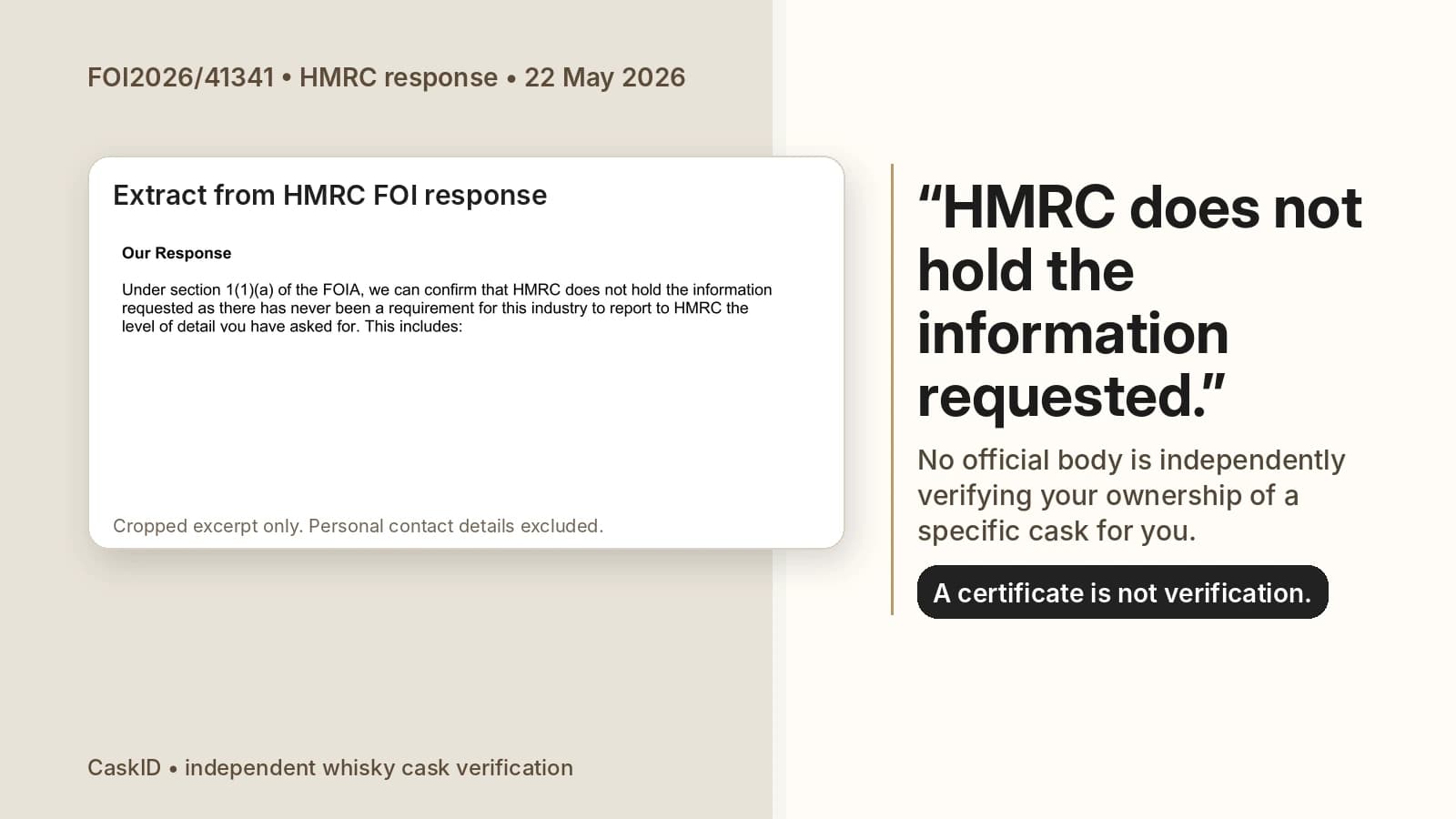
HMRC replied on 22 May 2026, reference FOI2026/41341.
What HMRC said
The response was short and clear. Under section 1(1)(a) of the Act, HMRC confirmed it does not hold the information. The reason given is the important part: there has never been a requirement for the industry to report that level of detail to HMRC.
HMRC added some context on a discretionary basis. Before 1 February 2025, the responsibility for retaining this data sat with the distilleries and then the warehouse keepers, not with HMRC. From that date a new single Alcoholic Products Producer Approval replaced the older patchwork of registrations and licences. HMRC also noted that its standard records retention period is generally six years plus the current tax year, so even where data exists it would not usually stretch back across a 20-year window.
In plain terms: HMRC does not hold a central, aggregated picture of what is sitting in Scotland's warehouses by fill year.
What HMRC regulates, and what it does not verify
It is worth being precise here, because this topic attracts a lot of loose claims.
HMRC absolutely regulates bonded warehouses and the collection of excise duty. Warehouse keepers are approved and supervised. A bonded warehouse holding a whisky cask is a regulated environment.
What HMRC does not do is maintain an investor-facing register showing who owns which individual cask, or assess whether a cask investment is legitimate. There is no central register of whisky cask ownership in the UK. None. Nothing ties your name to a specific cask, and nothing would flag if that same cask were quietly sold to three other people. HMRC's role is duty and warehouse compliance, not whisky cask ownership and not protecting buyers.
This is the distinction CaskID exists to address: not whether a warehouse is bonded, but whether a specific buyer can independently evidence that a specific cask exists, matches the paperwork, and is properly attributed to them.
It is also worth keeping the two findings separate. Our FOI confirms only that HMRC does not hold the aggregated stock data we requested. The absence of an investor-facing ownership register is a separate point, based on how cask ownership and bonded warehouse records work, not something this single letter was designed to prove. Both lead to the same place: no official body is independently verifying your ownership of a specific cask for you.
Why this matters if you are buying a cask
Whisky cask investment is not regulated by the Financial Conduct Authority. Because a cask is a physical asset rather than a financial product, buyers do not get FCA protection, the Financial Services Compensation Scheme, or the Financial Ombudsman. The Advertising Standards Authority has ruled whisky cask investment adverts misleading, including a 2023 ruling against Whisky Investment Partners, and now requires such adverts to make clear that the investment is unregulated and that values can go down as well as up. But that is about advertising, not about confirming that your cask is real and yours.
This is exactly the gap fraudsters have exploited. The two most common whisky cask investment scams are simple:
- Casks that do not exist. Slick brochures, a distillery name, a projected return, and no actual spirit in any warehouse.
- The same cask sold to multiple buyers. The seller keeps the cask, issues paper certificates to several investors, and relies on the fact that almost nobody independently checks with the warehouse.
A 2025 BBC investigation found investors had lost millions to misrepresented or non-existent casks, in one case through a company run by a previously convicted fraudster. The City of London Police, the UK's lead force for economic crime, and City of London Trading Standards have publicly warned consumers about misleading whisky cask investment schemes.
The common thread in every one of these cases is the same. There was no independent confirmation that the cask existed, that it matched the paperwork, and that the buyer actually held title to it. Buyers trusted a certificate.
A certificate is not verification
A certificate is only as good as the party that printed it. In the scams above, the certificates looked immaculate. They were also worthless, because nobody had checked whether the cask behind them existed, matched the paperwork, or had already been sold to someone else. A document about a cask is not the same as a verified cask. Fraudsters are betting you will not know the difference.
How to verify a whisky cask
If you are buying or already hold a cask, the checks that matter are the ones the official system does not do for you:
- Confirm the cask exists in a named bonded warehouse. Get the warehouse name and the cask's identifiers, and confirm them with the warehouse directly, not through the broker.
- Check the cask identifiers are complete. A genuine cask has a cask number, a fill date, a spirit type, and a regulated warehouse. Vague or missing identifiers are a red flag.
- Establish clear title. Your paperwork should unambiguously show that you, not the broker, hold beneficial ownership. A delivery order or a seller's certificate is not the same as confirmed title.
- Be sceptical of price. Casks sold at a large premium to any reasonable trade level are a classic scam signal, alongside guaranteed returns and pressure to act fast.
- Keep your own records. Storage arrangements, fees, and ownership documents, kept independently of the seller.
How CaskID closes the verification gap
The FOI response confirms in writing what the scam wave already suggested. There is no central authority holding the data that would let a cask buyer independently confirm what they own. HMRC does not hold it. The market is not FCA-regulated. The operational records sit with distilleries and warehouse keepers, but operational records are not the same as a public or investor-facing ownership register.
That is the gap CaskID was built to close. We are an independent whisky cask verification platform. We are not a broker and we do not sell casks, which means we have no incentive to confirm a cask that should not be confirmed. Our verification combines a multi-model computer vision pipeline with multi-party confirmation across brokers, warehouses, and distilleries, so that ownership and authenticity are checked against the people who actually hold the spirit, rather than against a certificate.
Independence is the whole point. The verification has to come from someone with no stake in the sale.
Frequently asked questions
Does HMRC keep a register of whisky cask owners? No. HMRC regulates bonded warehouses and excise duty, but it does not maintain an investor-facing register showing who owns each individual cask. We confirmed under a Freedom of Information request (FOI2026/41341) that HMRC does not even hold aggregated cask stock data by year of fill.
Is whisky cask investment FCA regulated? Generally, no. Buying a cask as a physical asset is not the same as buying a regulated financial product, so FCA protections, the Financial Services Compensation Scheme, and the Financial Ombudsman do not apply.
Is a cask ownership certificate or a Delivery Order enough? No. Any paper document is only as reliable as the party issuing it. Buyers should seek independent confirmation that the cask exists, matches the paperwork, and is held in a named bonded warehouse.
How can I verify a whisky cask? Confirm the warehouse, cask number, fill date, spirit type, storage status, and title position independently, rather than relying only on the seller's documents. Where you cannot do this yourself, use an independent verification service that is not also selling casks.
The takeaway
Nobody official is independently confirming your cask for you. HMRC has now confirmed, in writing, that it does not hold the aggregated data many people assume it does. The regulator that exists oversees duty and warehouses, not investors. In an unregulated market full of paper certificates, independent verification is not a nice-to-have. It is the only thing standing between you and the two oldest scams in the book.
Already own a cask? CaskID can independently verify whether the cask exists, matches your paperwork, and is properly attributed to you.
Calum Macpherson is the founder of CaskID, an independent AI-powered whisky cask verification platform. The HMRC response referenced above (FOI2026/41341, 22 May 2026) is available on request.