A summer when single casks are setting the tone
The summer 2026 auction calendar is unusually concentrated on single cask and single barrel bottlings. Sotheby's is running its New York "Whisky & Whiskey | Single Cask Summer" sale from 11 to 26 June 2026, comprising single barrel and single cask bottlings. That sale includes two single barrel Pappy Van Winkle expressions never before seen at auction, alongside high-value bourbon, Scotch and Japanese rarities. In parallel, Whisky Auctioneer's "Kisetsu: Seasons of Japanese Whisky" sale closed on 22 June 2026 and featured a Yamazaki 55 year old and a Karuizawa 1960 52 year old from Cask No. 5627.
This matters for cask investors, even if you have no intention of bidding. The route most cask owners eventually plan, whether they admit it or not, is bottling. The bottles produced from a privately owned cask end up in exactly the secondary market these sales represent. What that market is willing to pay depends as much on documented provenance as on what is in the glass.
Why "single cask" is a provenance claim, not just a flavour claim
A single cask bottling is a marketing description that carries a chain-of-custody assertion. It says every bottle in a release traces to one specific cask, with one production date, one warehouse history and one set of paperwork. Buyers at the top of the market are paying for that specificity. Whisky Advocate noted that June's auction schedule has been the busiest of the year so far, with competition for the highest hammer prices, and competition has been concentrated on bottlings with clear, named cask references.
The point for investors is straightforward. If your eventual exit is to bottle and sell, the value of the resulting bottles will be inspected against the same provenance standards now visible at Sotheby's and the major dedicated houses. Gaps in the cask record do not disappear at bottling. They become questions on the lot description.
What the broader auction data suggests
Activity is not limited to the headline trophy lots. Whisky.Auction's June 2026 sale was topped by a Macallan Private Eye, bottled in 1996 with a Ralph Steadman illustration to mark the satirical magazine's 35th anniversary, which sold for £2,500. That is a useful data point because it is a known release with a clean history. Buyers can verify the bottling year, the artwork, the count and the back story. Lots without that clarity tend to trade at discounts or, increasingly, not at all.
Live tasting and festival attendance reinforces the same point. The Spirit of Speyside Whisky Festival ran in Speyside from 29 April to 4 May 2026, hosted more than 600 events and surpassed £500,000 in ticket sales for the first time in its 27 year history. Tamdhu 21 year old was named the overall winner of the 2026 Spirit of Speyside Whisky Awards. International attendance and competition recognition feed bottle-market demand for named, traceable expressions. They do not, on their own, lift bottles whose cask history will not stand up to inspection.
The cask-level gap that affects bottle value
The verification problem is not new. There is no central register of cask ownership in the UK. HMRC neither holds nor verifies cask-level ownership data. The Finance Act 2006 removed the legal standing of Delivery Orders as proof of ownership, which left a gap that the market has not closed. For cask owners planning to bottle and resell, this gap is the single most underestimated risk to their realised return.
A buyer at a serious auction will not accept "the broker said the cask is mine" as sufficient evidence. They will look for:
- A current warehouse confirmation, in writing, naming the owner and the cask reference.
- Original new-make or filling documentation, where available, that ties the cask number to a distillery and a fill date.
- A consistent chain of transfers, with each step documented at the warehouse, not just on a broker's letterhead.
- Regauge records showing volume and strength over time, consistent with the claimed history.
If any of those is missing or inconsistent, the bottle release built on that cask inherits the doubt. That tends to show up as lower hammer prices, refused consignments, or longer due-diligence times that close quickly moving sales windows.
Lessons from historic bottle-market fraud
The bottle market has been burned before. The fake Macallan 1878 case, publicised in 2017 when a glass sold in a Swiss hotel for the equivalent of around 10,000 US dollars was confirmed as a forgery, is still a reference point for auction-house due diligence. The detail that matters now is not the bottle itself but the lesson: when a high-value claim cannot be verified back to a credible source, the market eventually corrects, often abruptly. Cask-derived bottlings face the same logic. A confident provenance chain protects price. A weak one invites discounting.
What cask investors should do before they exit
Whether you are years away from bottling or weeks away from instructing an independent bottler, the verification work is the same and is easier to do before contracts are signed than after.
Confirm the cask exists, where you think it is, in your name
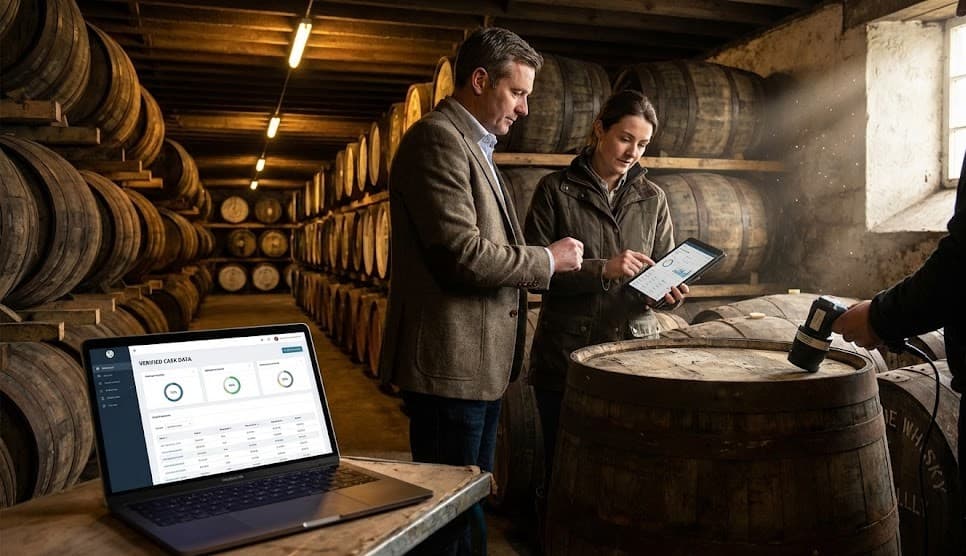
Get a current warehouse confirmation that names you (or your nominated holder) and the specific cask reference. A broker statement is not the same thing. If the warehouse cannot or will not confirm directly, treat that as the most important fact you have learned.
Reconcile every number
The cask number, fill date, original litres of alcohol (OLA), regauge dates and strength should be internally consistent and consistent with what is plausible for the distillery and fill type. Round numbers, missing regauges and inconsistent ABVs are common signs that documentation has been reconstructed rather than recorded.
Keep cask images under independent review
Photographs are routinely reused across listings by fraudulent or careless sellers. Image-level checks against known databases can identify whether the same cask end is being marketed as several different casks. CaskID Vision, the AI image-comparison pipeline used by CaskID, exists precisely to surface this kind of duplication before money or paperwork moves.
Plan bottling with a documented chain
If your exit is bottling, the bottler you choose should accept a full provenance pack and reference it on the label or accompanying documentation where permitted. Auction houses are increasingly explicit about what they want to see. Building that pack at exit is too late.
The takeaway
The summer 2026 auctions show a clear market preference for bottlings whose story can be inspected end to end. That preference rewards careful cask owners and penalises those who relied on broker assurances. CaskID is independent and does not sell casks, so its only role is to confirm what the documentation, warehouse, and images actually support. For investors thinking about their exit, that confirmation, done early, is what protects the value the auction market is currently willing to pay.