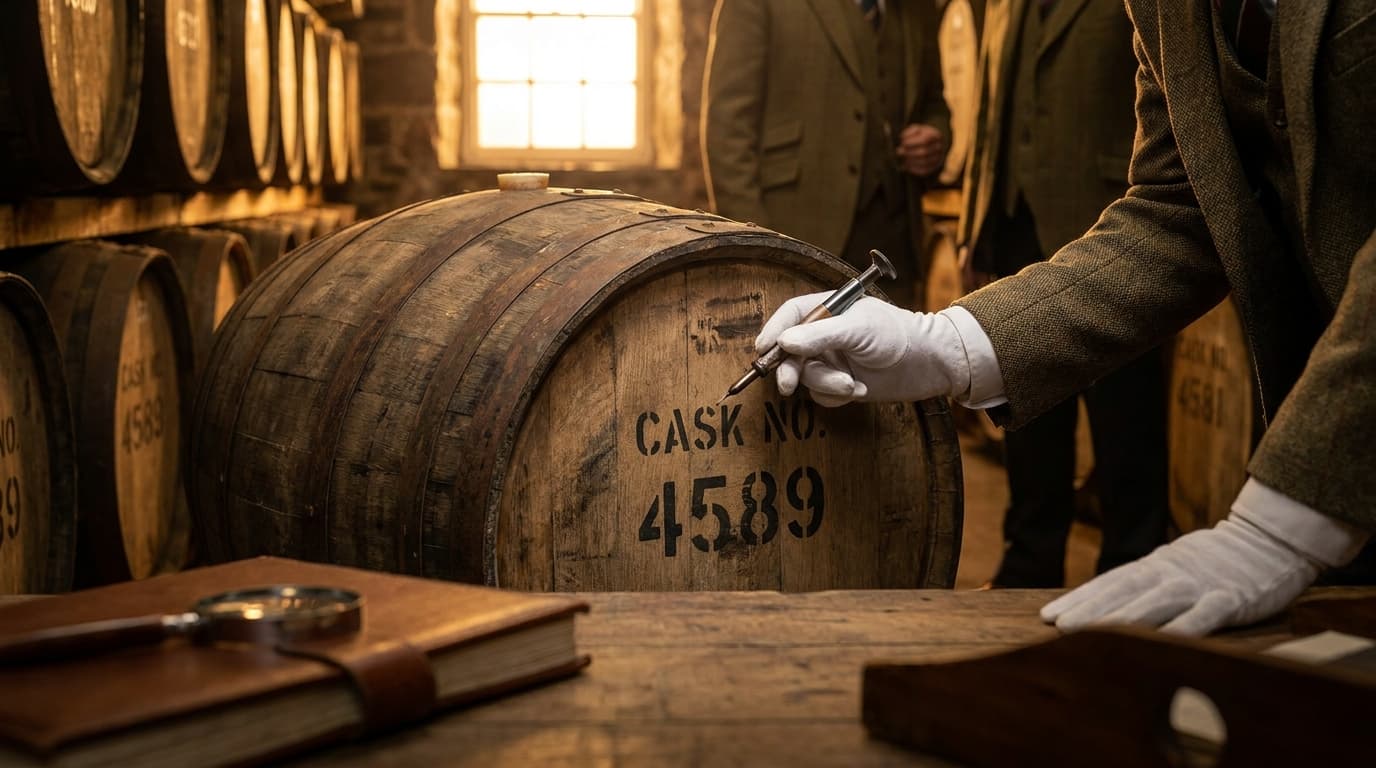
Almost every whisky cask quote leads with the same thing: a distillery name, a year, and a cask number. It looks specific. It looks like proof. It reads like a title deed. It is none of those things.
A cask number is an identifier. It is not evidence of ownership, evidence that the cask exists, or evidence of what is inside it. For an investor, mistaking an identifier for proof is one of the easiest ways to lose money in this market, and it is the pattern that has run through most of the collapses and enforcement actions of the last eighteen months.
What a cask number actually is
A cask number is a reference assigned by the distillery at filling. It travels with the cask through its life in bond, appears on paperwork, and eventually turns up on the bottle if the cask is ever released as a single cask.
Cask numbering is not standardised across the industry. Some distilleries use a simple sequential number based on the order of filling, while others use a code that incorporates the year of filling, batch number, or cask type. That variation matters. It means a "cask number" can mean different things at different sites, and it means the number on its own tells you very little without context.
The number is also not a system-wide unique identifier. There is no central register that guarantees a given number refers to one cask and one cask only across Scotland, Ireland or anywhere else. Warehouses maintain their own stock references, distilleries maintain theirs, and HMRC does not maintain cask-level ownership data at all.
What a cask number does not prove
It helps to separate what a cask number does from what investors often assume it does.
It does not prove ownership
A cask number is a label on an asset, not a title to it. Ownership is meant to be evidenced by transfer documentation, and traditionally by a Delivery Order. A proper Delivery Order should include the full names of both buyer and seller, the cask reference number, details of the whisky including type, distillery and year, and the warehouse and address where the cask is stored.
The complication is legal. The Finance Act 2006 removed the legal standing of Delivery Orders, which means a piece of paper naming you and quoting a cask number no longer carries the weight it once did. What matters now is whether the warehouse actually records you as the owner against that specific cask.
It does not prove the cask exists
Fraud in this market has repeatedly featured casks that were never in the warehouse, or were never filled at all. The recent shutdown of Cask 88 and Braeburn raised alarms and Whisky Merchants Limited folded in May 2025, leaving investors panicked and scrambling to find their casks of whisky. In each case, the paperwork existed. The casks, in many instances, were another question entirely.
It does not prove uniqueness of sale
The most damaging pattern is duplicate sale. Serial conman Craig Brooks, operating under multiple aliases, founded companies that sold non-existent casks, resold the same cask multiple times or charged wildly inflated prices. Nothing in the cask number itself prevents a seller issuing paperwork for the same cask to two, three or more buyers. The number is a shared reference, not a lock.
It does not prove contents
Cask numbers do not travel with an updated statement of what is in the cask. Volume drops through evaporation. Strength falls over time. A cask can be regauged, re-racked into a different vessel, or reduced to a point where it can no longer legally be called whisky. None of that changes the number. The number remains constant while the value beneath it can change substantially.
Why the gap exists
The UK cask market sits in a specific structural position. It is not FCA-regulated. HMRC neither holds nor verifies cask-level ownership data. There is no central UK register of cask ownership. The Finance Act 2006 change to Delivery Orders removed one of the few pieces of documentation that used to carry weight on its own.
Into that gap steps a mixture of legitimate brokers, warehouses that vary in what they will confirm to a third party, and a rotating cast of sellers whose ownership structures and paperwork practices are not always what they claim. The cask number is often the only thing an investor is given that feels concrete. It is the thing that gets typed into a spreadsheet. It is also the thing that fraud is most likely to attach itself to.
What actually needs to line up
For a cask number to mean something, it has to be tied back to a set of matching facts, held by parties who have no reason to lie about them.
- Distillery match. The cask number should correspond to a filling at the named distillery, on a date the distillery's own records would recognise as consistent. Sequential numbering resets and coded numbering schemes need to be interpreted correctly, not just quoted.
- Warehouse confirmation. The bonded warehouse should be able to confirm that a cask with that identifier is in its stock, at the stated volume and strength, held to the named owner. This is the single most important cross-check and the one most often skipped.
- Regauge alignment. A recent regauge report should match the paperwork. Volumes shrink over time. If a five year old refill hogshead is quoted at fresh-fill volumes, something is wrong.
- Documentary chain. Where a cask has changed hands, the chain of transfer should be reconstructable rather than assumed. A single Delivery Order in isolation is not the same as a coherent chain.
- Image evidence that has not been reused. Sellers routinely provide photographs of the cask. Those images should be unique to that cask and not be circulating elsewhere online or in other sellers' listings.
CaskID exists as an independent register for verifying whisky cask ownership, cross-checking distillery, warehouse, documentary and image evidence against the number on the paperwork.
The pattern the recent cases show
The July 2026 ASA ruling against Capgroup, the May 2026 Cask 88 and Braeburn collapse, and the older Craig Brooks cases all share a feature. In each, the cask number was quoted with confidence. In each, the number alone did not survive independent scrutiny. The information a buyer needed to protect themselves was not on the front page of the brochure. It was the warehouse confirmation, the ownership record, the image match, and the regauge that never happened.
The practical takeaway
Treat the cask number as the start of verification, not the end of it. It is the reference you cross-check other evidence against. It is not the evidence itself.
Ask what the warehouse will confirm in writing. Ask to see a current regauge. Ask whether the images provided are unique to that cask. Ask how ownership will be recorded, and by whom, and whether that record can be independently checked after the sale completes.
A cask number in isolation is a promise. Ownership only exists where that promise is verified against sources that have no reason to bend the truth.